Rosenqvists Announces Software and Hardware Advancements in Key Areas
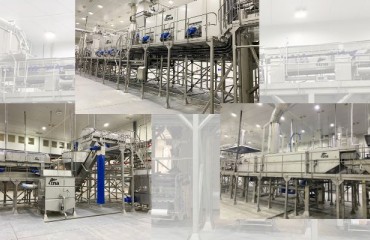
Rosenqvists just revealed a new line of automation software. The experts at the organization were able to create a new user interface for the operators thanks to Siemens' new platform. Additionally, the company announced a clever design for gliding strip wear indication and a new material for leaf springs in vibratory conveyors.
“Daily operations continue at a fast pace at Rosenqvists Food Technologies, solving new design challenges. It makes me happy and proud to see all the improvements we manage to implement in projects we are working on. […] We listen to what our clients need, and we are ready to adapt our design to make it fit perfectly. […] Moving forward, we proceed our focus on food processing and, of course, especially potato processing,” Stefan Björk, Rosenqvists Food Technologies’ Managing Director, wrote in a recent company newsletter.
A New Set of Views and Images for the Operator Touch-panel
The message states that the most recent version of Siemens' Simatic WinCC Unified software is now the foundation for all control systems. The company's automation team has created a new set of views and pictures for the operator touch panel with a focus on usability. providing a comprehensive overview that is simple to understand and offers instructions in detail.
“The operator gets a helping hand to start the processing line, to stop for cleaning/maintenance, and other operational stages in production. Management of fryer settings and recipe handling for seasoning applications. All - easy to operate. As before, all control systems are equipped with an R-Connect unit, a VPN Cloud-based system. It allows our clients to troubleshoot and make updates with the help of our remote support,” the newsletter reveals.
New Material for Leaf Springs and Introducing Wear Indicator for Gliding Strips
The Rosenqvists' designs have always been centered on a low total cost of ownership. Therefore, it is crucial to maximize production hours with few stops and a small number of replacement parts.
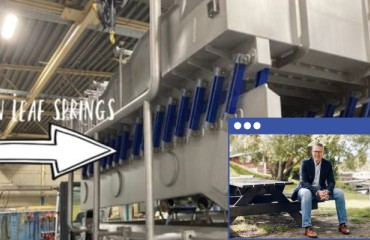
On vibratory conveyors powered by out-of-balance motors (a conveyor adjusted specifically for natural frequency), the trough is supported by leaf springs. The model is called VibRU in the lineup from Rosenqvists Food Technologies.
“The vibratory conveyor needs a suitable stroke consistently to operate efficiently. It is recommended to check the stroke level with the help of the sticker on the conveyor daily. If you notice a change in noise level, it can indicate that the stroke has changed. Leaf springs and a leg spacer in perfect condition are crucial to maintain the stroke. If they are broken or loose, it will affect the distribution of your product and you risk damages due to uncontrolled vibrations. For this reason, make sure you check the tension of the leaf springs weekly. Please, replace them as soon as you suspect they are worn out. Our customer service team is now gradually introducing a new material for the leaf springs used for support,” the company recently wrote in a newsletter.
In contrast to the previous generation of white leaf springs, this new material is food-grade and blue in hue. The business will progressively roll out the new material for all newly constructed machines as well as for service sales.
Additionally, gliding strips made of plastic or Teflon are used by the company's experts to safeguard and preserve the lifespan of the stainless steel belt. The strips protect stainless steel chains and belts against deterioration and wear. They can be discovered by customers on the fryer infeed belt, the chips defatter, the blanchers, and the inspection belt after frying.
According to experts, if the gliding strip is damaged or not in its ideal position, clients run the risk of the frying belt becoming worn out.
“Avoid this problem by checking the strip every month. It is easiest done after cleaning before you start up the processing line,” the engineers mentioned.
Lastly, according to the company's representatives, Rosenqvists is progressively adding a smart design for the gliding strip, which employs a wear indicator to help the customer's maintenance team evaluate whether or not the gliding strip needs to be replaced.
“The principle is simple; 3 mm before the plastic strip is worn out you find the wear indicator - a molded edge. Time to replace the gliding strip is the signal we want to convey,” they concluded.