Gentle Handling During All Three Stages of Potato Transportation is Critical
Potato transportation is divided into three stages: pre-process, during-process, and post-process. In pre-processing, most customers transport potatoes by truck, typically in 12 to 16-meter enclosed vans, with rail cars as another option.
Potatoes can be shipped loose in bulk or crates or totes weighing 1-1,5 tons. A series of conveyors transport potatoes during and after processing.
Gentle handling during all three stages of potato transportation is critical because it affects both yields (e.g., reducing bruising, slivering, breakage, and finished product seasoning adherence) and finished product quality.
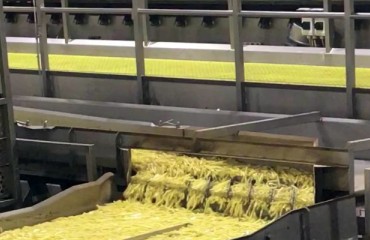
In potato processing, four primary conveyor systems are used: belt, flume, horizontal motion (or fastback), and vibratory (when required).
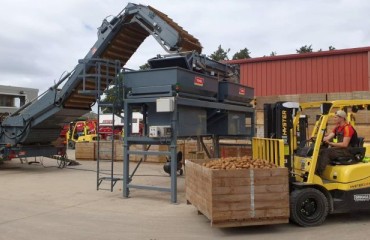
The handling of products on a potato processing line begins at the farm. Different methods of unloading spuds can be used depending on how they are shipped (truck vs. rail).
“For example, when shipped loose in bulk, using a truck dumping system for unloading is common. In this case, the tractor and trailer are elevated to a 40-degree angle and the potatoes are poured out of the back of the truck. The truck dumping system is the fastest way to unload potatoes; 25-30 tons of potatoes can be unloaded in less than one hour (the rail car option is similar). The potatoes are conveyed via a series of conveyors into the plant where they are stored in large bins capable of holding 30-45 tons of potatoes per bin. Alternatively, the potatoes can be put into crates for longer-term storage. If the potatoes are shipped in crates, a forklift is used to unload the truck and bring the potatoes to the plant. If the potatoes are shipped by rail, a sluice unloading system can be employed where the potatoes are washed in the railcar using a high volume of recirculated water,” Rick Bajema, Heat and Control director of Raw Material Processing Innovation told Potato Business.
Machinery Developers Try to Minimize Product Drops
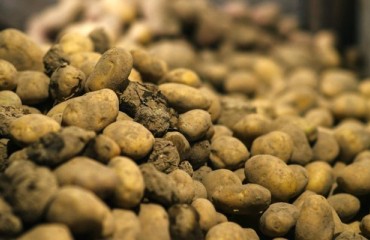
On a potato processing line, product handling begins with raw receiving, where sanitation is critical. Heavy-duty machinery washes and removes stones and debris, and grades whole potatoes by size. Belt conveyors or vibratory shakers are used for dewatering, conveying, spreading, collecting, aligning, and distributing whole potatoes in this application.
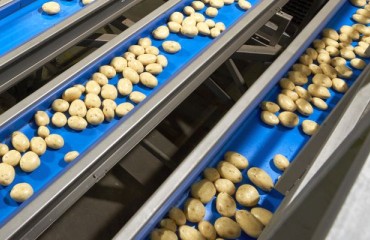
Wet strips are handled by lighter-duty rotary sizing and grading systems, while wet and frozen potato products are transported by belt conveyors or vibratory systems. Throughout the process, machinery designers minimize product drops as much as possible to avoid bruising and breaking.
“After the product is washed, destoned, peeled, and cut, sanitation becomes of great importance, along with maintenance. Here, vibratory equipment is widely considered a ‘best practice’ solution that maximizes both sanitation and reliability, because it has very few moving parts and presents a bed surface that is easy to clean,” Rudy Sanchez, Process Systems Product Development manager at Key Technology told Potato Business.
Conveyors with intentionally low sanitary design standards are frequently found in potato processing plants at raw receiving, where heavy-duty construction allows them to convey product mixed with dirt and rocks in dusty and sometimes muddy environments.
You can read the rest of this article in your complimentary e-copy of Issue 3 of Potato Business Dossier 2022, which you can access by clicking here.