Net Zero Project Strategy Research to Reduce the Potato Industry's Carbon Footprint
The potato supply chain is working on ways to reduce the carbon footprint of the crop as a result of climate change, driving extreme weather occurrences, and industry promises to reach net zero.
According to Andrew Blair, field technical manager at Branston, the largest supplier of potatoes in the UK, a project funded by Innovate UK is looking into ways to cut the carbon footprint of the potato industry, from growing through storage and transportation.
The Branston's Net Zero project, now in its second of three years, is collaborating with partners agritech company B-hive Innovations, the University of Lincoln, crop storage technologists Crop Systems Ltd, and numerous growers to develop a method that will achieve the least amount of GHG emissions while still producing a commercially viable crop.
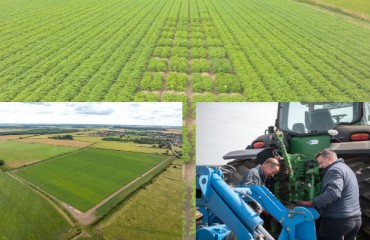
The project's major objective in this year's Net Zero field trials, which are being carried out with David Armstrong Farms in Lincolnshire and Arbikie Farming in Scotland, is to maximize crop nutrition. Although nitrogen fertilizer is a crucial component of growing a crop of potatoes, it also contributes significantly to the carbon footprint of the crop.
“As with most other conventional field crops, a good dose of fertilizer is needed to encourage plant growth and boost production. We are looking at the potential to reduce reliance on synthetic fertilizers through a range of different trials - from novel sources of fertilizer as well as the potential for reducing fertilizer inputs and recycling nutrition in the field. In both trial fields, we’ve established a baseline plot with no nitrogen applied. Then we’ve set up further plots with varying levels of nitrogen application, both from conventional and novel sources. We’re already noticing differences in the color and vigor of the canopies, and it will be interesting to see what variation we get in yield at harvest,” according to a recent press release.
Testing Plant Feeding Levels
The engineers involved also assess how much they can feed through the leaf as the crop is growing. R-leaf is a new technology that has the potential to change the way we think about crop nutrition.
Crop Intellect developed the photosynthetic catalyst, which is sprayed onto the leaf and, in the presence of sunshine, converts atmospheric NOx gases such as nitrous oxide (N2O), nitric oxide (NO), and nitrogen dioxide (NO2) into nitrate that the plant can utilize. R-leaf could allow growers to reduce fertilizer use at planting while knowing they can top up throughout the growing season.
“To work out what the plants need as they grow, we’re evaluating a new system from Piketa, which will give in-field, real-time nutrient analysis via the leaves. This has the potential to save the cost of lab analysis and allow growers to respond immediately by feeding the crop what it needs when it needs it,” the press document reveals.
The carbon footprint of producing synthetic nitrogen fertilizer is already well documented. What we’re particularly interested in for the Net Zero project is what happens as the crop grows and the fertilizer breaks down in the soil. On this project, we’re working closely with the University of Lincoln looking at soil health and gaseous emissions at field scale throughout the growing season.
Nitrous oxide - which is 265 times more potent greenhouse gas than carbon dioxide is released from the soil as synthetic nitrogen-based fertilizer is broken down. The University of Lincoln is measuring this important greenhouse gas throughout the growing season across all the fertilizer plots.
They are also collecting and analyzing the CO2 and other gases that are released from the soil, across the fertilizer trial and the range of different types of cultivation that are also part of the Net Zero field trial.
A Commercially Viable Crop
Different potato cultivars may potentially have an essential influence in lowering production's carbon footprint. Plant breeders are testing new varieties to discover which ones can operate at low nitrogen levels and produce a quality, high-yielding crop with less irrigation and worse-quality land.
“While much of the work that is being undertaken is around reducing inputs, the team is well aware that yield and quality are still very important. Any reductions that lower the marketable yield could necessitate an increase in other inputs and be detrimental to the overall carbon footprint. We’re looking at ways to get the balance right for truly sustainable potato production. In reality, a step change is required from the potato industry as it looks to achieve ambitious net-zero targets. A ‘business as usual’ approach isn’t going to cut it anymore, and the responsibility rests across everyone involved to find solutions,” the experts involved concluded.