A Deeper Grasp of the Freezing Process' Basics
Because of the many advantages that frozen meals provide, like convenience, affordability, longer storage, and portion control, to name just a few, customers find them to be appealing. Food producers needed a deeper grasp of the freezing process's basics and how it affects food, to continue servicing the needs of consumers who seek high-quality products.
Freezing protects the quality of food, and the quality of the freezing method used impacts the organoleptic properties of food after thawing. Characteristics such as appearance, texture, taste, and smell are examples of organoleptic features.
Numerous studies have demonstrated that the freezing rate is the secret to high-quality frozen food - the quicker the freezing rate, the higher the quality of the food product.
Mechanical freezing and cryogenic freezing are two typical industrial freezing techniques. Traditional vapor compression cycle freezers, which resemble a home freezer and typically run at a temperature between -20° C and -50° C, are referred to as mechanical freezers. Mechanical freezers work by moving a refrigerant through the system, typically ammonia or a chemical refrigerant, which removes heat from the food item.
After being transferred to a condenser, this heat is released into the air or water. In an evaporator, the refrigerant itself - now a heated, high-pressure liquid - is introduced. It is cooled and vaporizes into a gaseous state as it moves through an expansion valve. It is now possible to reintroduce the gas into the system at low pressure and low temperature.
A very low-temperature gas, usually nitrogen or carbon dioxide (CO2), is circulated directly around the food to accomplish cryogenic freezing. Cryogenic freezing systems often operate under -70°C. Cryogenic gases have extremely low temperatures, hence food can be frozen in a matter of minutes as opposed to the hours it would take in a mechanical freezing system.
Categorizing the Modern Equipment for Freezing
There are several ways the industry can categorize modern equipment for freezing. Based on the way it operates, it can generally be integrated into the processing line for a continual flow, or freeze the product in batches.
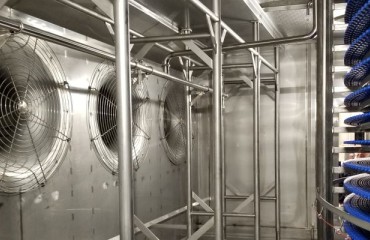
Depending on the heat-transfer method, freezing equipment can be classified into Air-Blast Freezers - using moving, frigid air to cool the food. These are the most common freezers and are available in many different designs; Contact Freezers – Conduction is the primary method of heat transfer. The food is frozen by bringing it in contact with extremely cold surfaces or by immersion in a cold liquid; Cryogenic Freezers – This technology uses liquefied gases, such as nitrogen or carbon dioxide, to produce frigid temperatures.
You can read the rest of this article in your complimentary e-copy of Issue 4 of Potato Business Digital 2022 magazine, which you can access by clicking here.