Fewer Dutch Organic Potatoes Last Year, But At Higher Prices
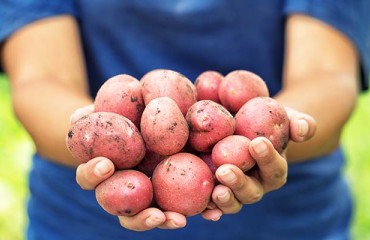
Compared to 2020, last year, the Netherlands' area of organic ware potatoes fell from 1,472 ha to 1,342 ha, which resulted in a decline in production. Most organic ware potatoes were produced for the fresh market, with Flevoland tater yielding more than half of the Netherlands' organic ware spuds.
According to the Agro-Nutri Monitor 2022 - Background Report - Monitor food pricing from the Wageningen Economic Research, organic potato prices were higher than the prices of conventional potatoes.
In fact, the Dutch potato growers were slightly more satisfied with the sales price in 2021 than with the margin achieved. Organic growers in particular (>60%) were satisfied with the realized sales price and margin (>50%). Growers of table potatoes with a non-organic sustainability label were less satisfied with the sales price and margin than conventional growers without a sustainability label.
In this face-to-face race (organic vs. conventional), the Dutch operating retailers had the biggest lion's share.
“The gross margin of the supermarket (measured as the difference between purchase and sales price) is significantly higher for conventional potatoes than for organic potatoes. This indicates that a larger part of the consumer euro of conventional potatoes ends up in supermarkets. [...] growers' prices fluctuate strongly during the year and also between years. The prices between the chain links grower, trade, and supermarket seem to follow each other over time,” the report reveals.
According to Wageningen experts, Dutch potato prices have a similar and erratic price pattern for conventional and organic varieties. Due to low output in the 2018's drought, both conventional and organic potatoes became scarce and very expensive later in the season (May-June 2019). The economic crisis in 2020 has had an impact on potato prices in supermarkets. The new crop's price dropped in the second half of 2020.
The Nederlanders Look for More Sustainable Potatoes
The report also shows that in the Netherlands, the market share of more sustainable potatoes is increasing due to the introduction of the On the way to PlanetProof quality mark in 2016, which is being used as a new standard by various supermarkets.
The costs for the cultivation of conventional ware potatoes over the period 2018-2020 were EUR0.14/kg and for organic ware potatoes EUR0.27/kg.
“Organic seed potatoes are more expensive. The costs of crop protection products for organic potatoes were virtually nil, but organic potato cultivation had more costs for weed control: extra own and hired labor (both classified according to the collective labor agreement standard) and specific mechanization for mechanical weed control,” the experts wrote in their report.
For the organic potatoes, the absolute gross margin at all chain links is greater than usual and a larger part of the retail price goes to the grower (EUR0.52 or 38%). The net margins for organic are lower in percentage than for conventional growers and supermarkets.
“Possible causes are smaller companies and smaller volumes, extra handling, more different batches/varieties, and more loss,” the experts explain.
2017-2019 Looked Better for the Dutch Organic Potato Growers
The previous monitor found that for the period 2017-2019, organic potato growers receive a selling price that reimburses all (extra) costs incurred. However, their profit (approximately EUR0.4/kg) was slightly more than half of the usual profit per kg (including non-organic product labels) (approximately EUR0.7/kg).
In addition, the previous monitor shows that for conventional table potatoes, the gross margin was distributed almost evenly over the three chain links. For organic potatoes, the absolute gross margin at all chain links was greater than for conventional potatoes and a larger part of the retail price went to the grower (53 euro cents, or 40%). The net margins for organic were lower in percentage than for conventional.
“Possible causes were that organic potato growers are more often smaller companies and produce and sell smaller volumes per hectare, from more different lots/varieties and have more shrinkage and incur higher costs per kg,” the report concludes.