AHDB: Latest Retail and Consumer Insights on Potatoes
AHDB's latest market intelligence report shares information on the ever-changing customer eating habits that have impacted retail and foodservice in Britain, particularly potatoes. The data provides figures for the 2017/18 crop year and the latest figures for the 2018/19 season (as of November 2018).
Potatoes in the retail market
The UK food and drink retail market is growing – there has been a value increase of 3.4% in the recent year, meaning it is now worth just under GBP113bn (Kantar Worldpanel, 52 w/e 12 Aug-18). A particularly strong performance in the past couple of years has meant that longer-term growth has accelerated to +6.3% versus the year ending August 2014.
According to Kantar Worldpanel data cited by AHDB, carbohydrates account for a 6% share of the food and drink retail market. The data shows this category has been in value decline over the longer term (-1.4% versus year ending August 2014) but growing in the shorter term (+3.0% versus year ending August 2017). There’s a similar story with potatoes (which account for 45% of carbohydrate value), with reversing performance in the last year (–4.3% versus year ending August 2014 and +1.1% versus year ending August 2017).
Approximately three-quarters of consumers agree that carbohydrates give you energy (76%), are a good fuel for sport/energy (72%) and are an important part of a healthy diet (72%) (AHDB/YouGov, Consumer Tracker, Aug-18). Health and convenience are key consumer needs, but perceptions on these aspects differ depending on the carbohydrate, which helps to explain sector performance. Currently, potatoes are perceived as the third healthiest carbohydrate (behind sweet potatoes and rice) and the third most convenient carbohydrate (behind pasta and rice). Rice and pasta, scoring higher on these aspects, are seeing stronger volume growth in the market, although remain a smaller share overall at 14% combined.
There is an opportunity to communicate the perceived benefits of potatoes over pasta and rice, with potatoes having a stronger link with fiber and keeping you fuller for longer. While 64% perceive potatoes as being easy to prepare, a significant gap to pasta and rice shows an opportunity to improve. Sweet potatoes are also becoming more established in the market, being positioned as healthy, less fattening and a good source of fiber.
Consumer preferences
Within the potato market, the biggest sector by value is fresh, accounting for 34%, followed by crisps at 32% and frozen at 25%.
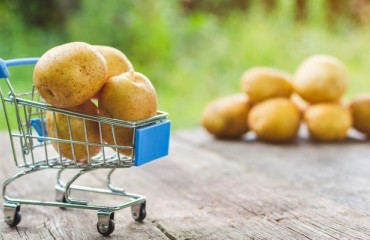
According to Kantar Worldpanel data, fresh potato value sales have continued their long-term downward trend over the past five years, declining by 19.6% versus 2014 and by 4.3% versus 2017. However, in the recent year, the volume of fresh potatoes sold in the UK retail started to recover, increasing by 0.4% in the year ending August 2018. This has reversed the longer term trend, with volumes of fresh potatoes now being up 1.9% versus 2014.
Volume growth for fresh potatoes in the recent year (year ending August 2018) comes from maincrop, which accounts for 61% of fresh potato volume sales and is up by 1.5% year-on-year. Baking potatoes are declining by 2.1% and new potatoes by 0.4%. The growth for fresh is driven by hard discounters at +2.9%, as other retailers are relatively stable.
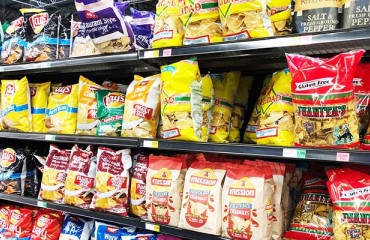
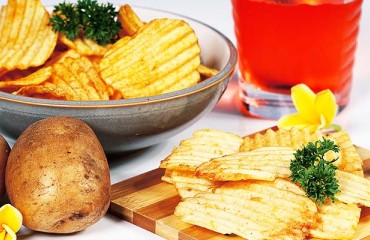
Crisps are the fastest growing potato category in both value and volume. In the year ending August 2018, value sales for the category grew by 4.5% and volume sales by 5.2%. Premiumisation in this sector is driving performance, with hand-cooked crisps and sharing bags performing strongly in the last year.
The frozen potato sector is now worth £735 million, with 63% of the value coming from frozen chips and 37% from other frozen potato products. The sector is growing in value by 3.2% year-on-year and volume by 0.6%. The volume growth is coming purely from frozen chips. They have seen a turnaround in performance thanks to more premium offerings in the market appealing to older consumers and smaller households, as opposed to just children.
The chilled potato sector represents a small proportion of the total potato market at 9%, but it is an important value-added segment. Value growth of +3.9% in the year ending August 2018 was driven by increased volumes (+1.7%) and rising prices (+2.2%).
The convenience of frozen and chilled potatoes is the reason why consumers are turning to these categories.
Potatoes in the foodservice market
According to MCA Insight as reported by AHDB, the implied value of the eating-out foodservice market fell by 3.5% in the year ending June 2018. This is attributed to a decline in eating-out visits, which are down by 5.5%. Average spend per visit is up by 1.4% because of menu inflation. A lack of consumer confidence and economic uncertainty has resulted in consumers treating themselves less often, eating out less when they are feeling lazy and removing eating out from their day-to-day routine.
In the year ending June 2018, 3.3 bn eating-out visits (the equivalent of 33.9% of total eating-out occasions) involved a potato product. This is 6.2% lower than in the year ending June 2017, so is declining faster than the overall market at –4.8%. Both full-service restaurants, which account for 44% of potato occasions, and quick service retail at 48%, are driving this. The loss in servings is the equivalent of approximately 23,455 tons fewer potatoes consumed in foodservice in the last year.
In terms of formats, all are declining – particularly chips/ wedges and fries, which account for 58% of potato occasions. The exception to this is hash browns, which account for 12% of potato occasions.
Out of home, potato products are most often consumed with fish (18.4% of potato occasions), beef burgers (16.2%) and a full English breakfast (9.9%). While the beef burger is in growth as offerings innovate, traditional British dishes are losing share to more adventurous world cuisines such as Portuguese and Middle Eastern. Therefore, for potatoes to reverse their decline in foodservice, traditional dishes should modernize and there should be a focus on providing inspiration for international potato-based dishes.
More than a bit on the side – a successful campaign
AHDB has also taken the opportunity to highlight the fact that their ‘Potatoes: More than a Bit on the Side’ campaign - which was launched in July 2015, utilizing EU funding, in conjunction with Bord Bia – proved to be quite successful. The aim of the campaign was to re-engage younger consumers with the potato, demonstrating its health and nutritional virtues, as well as showing modern and contemporary ways in which potatoes can be used to fit in with today’s busy lifestyles.
Purchase figures for fresh potatoes have shown an increase in volume since the start of the campaign (see above), with frequency of purchase also increasing steadily over recent years. This follows on from a long-term decline trend, starting in the 1970s.
AHDB has observed that consumer attitudes towards health messages associated with potatoes has increased from the pre-campaign tracking base, with 82% of consumers agreeing that “potatoes are healthy” (from a base of 68%), three-quarters agreeing that they are an essential part of any diet (60%) and 72% agreeing that potatoes are fat-free (55%). Versatility remains a key benefit for potatoes, with 92% agreeing that they are a versatile product.
Trade overview
AHDB’s report also notes that according to data from Her Majesty’s Revenue and Customs (HMRC) in the 2017/2018 season total UK potato exports increased by 11.2% to a total of 435kt. An increase in exports of processed potato products accounted for 93% of this movement. A marginal increase in seed exports accounted for the remaining rise. Exports of fresh potatoes fell slightly on the year, by less than a percentage point.
Total UK potato imports fell to 945 Kt in 2017/18 – down 4.8% from the previous season. A 74 Kt reduction in imports of fresh potatoes caused by high domestic production last season was a key driver. Imports of processed potatoes continued to increase this season, reaching 784 Kt – up 3.8% from 2016/17.
Most UK import and export trade continues to be intra-EU. In 2017/18, the UK exported 121 Kt of processed potato products to EU destinations – a 40.2% increase on the year.
During the same period, UK imports of EU processed potato products continued to increase, for the third consecutive season. Imports of fresh potatoes fell from the previous season – probably because ample domestic supplies reduced import requirements.
Imports of fresh potatoes tend to stay steady in a normal season. On average, over the past five years (2013–2018), the UK has imported 165 Kt of fresh potatoes from the EU each season. A reduction in European production is unlikely to reduce imported volumes as shown in 2012/13. A season of low supply caused by adverse weather, the UK still managed to import 683 Kt of fresh potatoes. However, the probable price increase of these supplies over the season means that cheap European imports are unlikely to act as a cap on domestic prices this season. This may exacerbate the issues that are expected to emerge in the domestic market this year.
In terms of extra-EU trade, UK seed continues to be the largest export product, with most seed sent to Egypt. With the opening of new markets for Scottish seed, including Kenya and China, we may see increases to other regions in the coming years. UK exports of processed potato products also continued to increase on the year.
Imports of fresh potatoes from non-EU destinations fell again to 49 Kt last season, with most of this tonnage of new potatoes being of Israeli origin. The limited quantity of fresh imports from non-EU destinations highlights the importance of European supplies to fulfill shortfalls in the domestic market. They are unlikely to be fully met by extra-EU suppliers because of the difficulties and costs associated with transporting fresh potatoes across large distances.