Finally Foods Strikes First Commercial Deal With CBC Group
Finally Foods, a molecular farming startup developing dairy proteins in potatoes, has signed its first commercial agreement with beverage and dairy producer CBC Group, which also led a $1.2 million investment round in the company.
The deal follows Finally Foods’ first field trial and will support the company’s efforts to scale toward commercial production.
“In a short period of time Finally Foods succeeded in achieving extraordinary results, from a successful field trial to a strategic partnership with CBC Group,” said Ofer Haviv at computational biology company Evogene, which has collaborated with the startup to accelerate the development of potato plants expressing high levels of casein proteins. “This is an additional step in proving that molecular farming is a real production alternative to animal-based proteins.”
Finally Foods CEO Dafna Gabbay told AgFunderNews: “At this stage I’m afraid I can’t share details of the commercial agreement. What I can confirm is that CBC Group is our first significant customer, which makes this partnership an especially important milestone for Finally Foods.”
Potatoes as protein producers
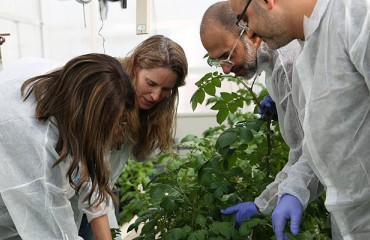
The company uses computational biology from Evogene to model the effects of different genetic modifications before moving to greenhouse and field trials.
“Our first field trial was very important as it demonstrated that our potatoes grow just like any other potato in open fields. In addition, the field trial was essential to generate the large quantities of potatoes needed to move our extraction process from the lab to an industrial scale,” said Gabbay.
She added: “Over the next couple of years, we will be assessing global territories for growing our potatoes, and regulatory processes have already begun in several regions.”
Scaling up and by-products
“Finally’s extraction process is cost-efficient and builds on existing industrial methods, while naturally requiring alignment with regulatory guidelines and considerations,” said Gabbay. “At present, we are finalizing our pre-seed extension round; as we move into the seed stage, we will certainly need to raise more capital to support and implement extraction at commercial scale.”
As for the potato fraction remaining after protein extraction, she noted: “We certainly plan to commercialize the by-products of our extraction process. As part of this, we separate the starch fraction of the potato and depending on its characteristics and the regulatory frameworks in different territories, we will determine the appropriate applications and market value.”
Producing casein inside plants
Explaining why the company chose potatoes over other hosts, Gabbay said: “We are not aiming to supply the market with a mixture of casein proteins and other proteins from the host plant. We produce clean, pure casein proteins without DNA from the genetically engineered host so that the final product is not a GMO.”
She added: “In the upcoming trials, scheduled for the coming months, we will optimize agronomic conditions and cultivate all the casein formulations we have developed. Producing all four casein subunits in the same potato variety is entirely feasible, and we hope to share positive news on this front in the near future. In parallel, we have already produced pairs of subunits and are now testing their functionality.”
According to Gabbay, the proteins also mimic natural micelle formation: “The whole brilliance of molecular farming is that the micelles are done [formed] inside the plant.”
Industry outlook
Commenting on the broader drivers for cow-free dairy, Gabbay said: “I don’t think that there is any major dairy company in the world that isn’t researching cow-less products, whether it is because of climate and sustainability reasons or because of concerns about meeting demand in the future. Avian flu in California affected cows as well [as chickens], so there are also concerns there.
“I think in future, we’ll have dairy from cows, from fermenters and from plants.”