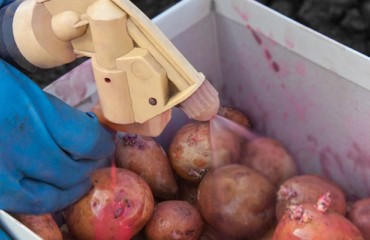
Australian project to develop a more reliable soil Phosphorus test

“Innovative Nutrient Management for the Australian Potato Industry”, a project developed by Department of Agriculture National Landcare Innovation, is now in its second year.
Managed by Potatoes South Australia Incorporated, the peak industry body for the potato industry value chain, and delivered by PIRSA’s consultancy business unit, Rural Solutions SA, the project will help develop a more reliable soil Phosphorus test, the Diffuse Gradient in Thin-films (DGT) test.
Correct application rates of phosphorous (P) are critical for the financial and environmental sustainability of the Australian Potato Industry.
The project aims to deliver 15 replicated trials and 9 demonstrations across the state to calibrate the DGT test for potatoes.
“We currently have 9 replicated trials across the state to assess the DGT test for potatoes. This involves applying 5 different rates of phosphorous to determine the yield response. We measure the amount of P in the soil using the common soil P tests, such as Colwell, Olsen and Bray, as well as the DGT test and follow this up with petiole P testing and then harvest each plot to determine the effect on yield”, said project leader Dr Melissa Fraser.
Harvest of the current trials in the South East, Mallee and Kangaroo Island is currently underway with more trials to be established in the coming weeks across the Murraylands, Riverland and Lower lakes. Potatoes South Australia CEO, Ms Robbie Davis, was in the SE recently to see the trials and was impressed by what she saw.
“The level of collaboration and cooperation between producers, service providers and researchers has been outstanding. Elders Ltd has come on board to supply fertiliser and support to the project, and APAL Agricultural Laboratory in Adelaide is supporting the project with soil and plant analysis”.
The DGT test has already been calibrated for wheat, barley, canola and peas in southern Australia by University of Adelaide researcher Dr Sean Mason and this project aims to determine the critical threshold P values for potatoes.
The development of an accurate, robust test will enable producers to quickly and easily analyse their soils and apply appropriate rates of Phosphorous fertilisers, improving both their overall economic return and reducing off-site environmental impacts caused by over-fertilisation.
“The critical part of this project is to relay the findings to the industry to enable increased profitability and reduce the likelihood of P loss into the environment” Ms Davis added. Whilst the field trials will be conducted in the major growing regions of South Australia, the results and critical values will be relevant nationally”.
An important plant nutrient
Phosphorus is an important plant nutrient that is required to ensure optimum productivity of agricultural and horticultural crops. Australian soils have inherently low P levels, so the application of P fertilisers is widely employed across cropping, horticultural and pastoral systems and is often a significant input cost. Whereas the application of P is vital to ensuring productivity, the over application of P has been shown to pollute waterways, causing eutrophication, and induce poor soil health. It is therefore both economically and environmentally crucial that accurate P application rates are applied to our cropping and pasture systems.