Employing Yield Monitors to Record and Manage Variability Across Fields and Farms
Potato growers are well organized and have no problem planning and executing the details related to planting, growing, storing, and shipping their crops. However, details related to each stage are often recorded separately and manually.
By Bill Menkveld, Sales & Admin., Greentronics Ltd.
Many growers feel burdened by the hours needed to pull all that information together and provide clear maps and reports that must show many details: dates, varieties, fields, equipment, yields, temperatures at harvest and in storage, number of loads, location of loads in storage, and shipping records. All these details are needed to prepare comprehensive and reliable reports required for traceability and food safety reasons. Unfortunately, such reports do not immediately provide the details needed to make agronomic decisions about crop production and management.
Many growers already employ yield monitors to record and manage variability across fields and farms. Why not add to this technology to include automatic recording and tracking (a.k.a geo-tracking) of crop details from field to storage? Some growers challenged Greentronics with this question. As a result, product development began in 2015 and eventually resulted in a new system named RiteTrace. The current version is focused on operations with bulk storage. Greentronics is planning a similar system for growers who store crop in crates and boxes.
Having All the Records Needed to Map Crop Location
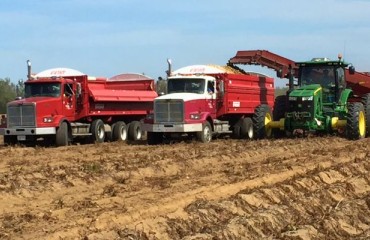
RiteTrace employs several monitors, scanners, transponders, and sensors designed specifically to automatically identify and track each load and piece of harvest equipment to place and position in storage. In the field, harvesters are equipped with yield monitors and IR (infrared) and ambient temperature sensors to map and log yield and crop temperature data as well as load, field, and variety totals. Harvesters also have scanners. These auto-link to transponders on trucks and carts that receive crop from the harvester. This way a record is created with exact GPS coordinates for the source of each load in each field and farm. The system also records other data such as time to harvest, load, transport, and unload. These data can help improve efficiencies on the farm.
Once a load arrives at the unloading point, another scanner creates a record for the load ID, as well as delivery and unloading times. Position sensors and a scale on the equipment that piles crop in the storage bins ensures RiteTrace has all the records needed to map crop location by date, field, and variety.
With additional hardware, RiteTrace can be expanded to allow seed potato tracking from storage to planter to field. Recent enhancements have been introduced for growers who use Crop Carts and Trans-loading in their operations.
You can read the rest of this article in your complimentary e-copy of Issue 3 of Potato Business Dossier 2023, which you can access by clicking here.