Drying and Dehydration Solutions for Any Process
The dryer a processor uses is dependent on the requirement of each particular process. This could involve drying down to an overall moisture of 8% or less, for shelf life, or simply to the removal of a small amount of surface water from a blanching or washing operation. Or, anything in between.
by Dan Orehov
For surface water and water near the surface removal, a simple single conveyor, forced convection dryer, such as an ‘SCF’ can be used, according to Ed Wozniak, of CPM Wolverine Proctor Ltd. Historically, potato has been dehydrated, in cubes, for preservation and shelf life, which still applies today, he said. When dehydrated to 8-10% moisture, the product is still acceptable, in some applications, when rehydrated. Still used today, for the small cubes in dry packet soup mixes, and army field rations, for example. In some cases, where the cut potato is further processed e.g. oil flash frying, a surface, or deeper drying is required. This will prolong the life of the oil, by reducing degradation by hydrolysis.
“However, for absolute control of the drying process, a multistage dryer is used. This has independent conveyors in a linear arrangement, within the one body. Each conveyor section body is further divided into individual zones; each of these zones can have a different temperature, air speed, humidity, and air direction. If needed, agitation or turning devices can also be added in these zones,” Wozniak explains. “By having this arrangement, we can release the product from one conveyor to another, at the critical stage. It also allows us to bulk up the product on the second and third conveyors, reducing the overall dryer length. Hygiene is important, and the first stage conveyor is normally the one that may receive contamination by starch residues, so belt wash systems are employed here,” he adds.
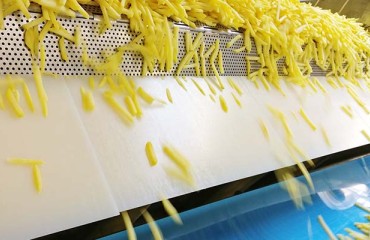
According to CPM’s representative, the number of zones and stages that these dyers have, especially when in conjunction with full plc control, allows for optimizing the production rate, production consistency and quality, as well as a fast product changeover. This style of dryer would also be used in pre-drying of French Fries, and irrespective of cut, be versatile enough to either surface dry, or indeed, dryer deeper towards the core, while minimizing any breakages.
In some cases, the raw fries are also coated with a starch slurry, which these units can also contend with. There are products such as Pomme Dauphines, that are processed, and these can either use the forced convection system, or much higher air velocity units such as Impingement Ovens, which are also capable of surface color production, if required. In the case of smaller capacities, or specialty products, CPM Wolverine Proctor can also provide batch dryers of the ‘Tray’ or as they are sometimes known ‘Truck’ dryers. These ensure a considerable drying area within a small footprint. However, the loading and unloading of the trays is manually intensive. Energy costs per kilogram of product are typically lower than continuous dryers, even though the drying process in these units is 3-5 times slower. Lastly, where space is at premium, it may be possible to stack multiple conveyors vertically, as in the company’s ‘MCD’ multi conveyor dryers, rather than arrange them horizontally. However, there is typically less control, and longer drying times involved when MCD’s are used, according to Wozniak.
“The features that have been setting our dryers apart for decades, and still true, is the ‘total life costs’ of our dryers. Meaning that the build standard and components used minimize downtime for mechanical maintenance and coupled with our plc controls ensure optimal running costs, for many decades. The modular construction of our systems, also future proofs the dryer, should expansion be required. It also allows for a customized and flexible approach, in giving the right size, exact configuration and functionality to the customer, all within a value for money package. Of course, we must not forget the after sales support. This is not only on parts that many be required, but also on machine, and process audits. This is carried out by people that understand the product and process, and not just the dryer. We pride ourselves on having one of the best after sales teams globally,” Wozniack concludes.
You can read the rest of this article in your complimentary e-copy of the March/April Issue of Potato Processing International magazine, which you can access by clicking here.