Clean Processing: Closing The Loop On Heat, Steam And Exhaust
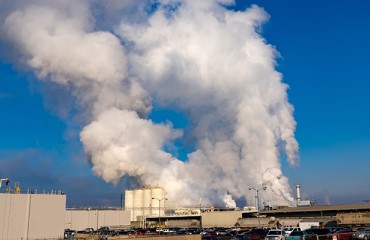
In industrial potato processing, direct emissions originate almost entirely from thermal unit operations. Blanching, drying, frying and flake production all involve large transfers of heat and moisture. In conventional plants, the engineering priority has historically been stability and throughput rather than containment. Steam generated during drying is vented through flues, fryer exhaust air is diluted and discharged, and surplus heat is rejected because capturing it complicates hygiene control and process stability.
From a physical standpoint, emissions-free processing does not mean eliminating heat or evaporation. Potatoes must still lose moisture, and energy must still be supplied. What changes is whether those flows are allowed to leave the factory boundary. Steam and exhaust become losses only when they exit the system uncontrolled. If they are captured, condensed or reused internally, they cease to be emissions in the regulatory and practical sense.
This distinction explains why electrification or renewable energy sourcing alone does not address most visible emissions in potato plants. Even a fully electrified fryer or dryer will emit large volumes of moist exhaust air if the process design remains open. In many facilities, the most visible and odorous emissions are unrelated to fuel combustion and instead come directly from evaporated product moisture entrained in air streams.
Achieving meaningful emission reduction therefore depends on redesigning interfaces between unit operations. Moisture and heat must be captured at source, separated from ambient air, and reintegrated elsewhere in the process. The limiting factors are control, hygiene, fouling and variability. Recent developments in potato processing equipment show how these constraints are starting to be overcome.
Closing Steam Loops In Flake Production
Flake production is one of the clearest examples of how process emissions can be eliminated at source. Drum dryers evaporate large quantities of water, generating steam that has traditionally been extracted together with air and vented. This approach is robust but inherently wasteful and results in visible steam plumes and odour emissions.
Tummers Food Processing Solutions has addressed this through its Emission-to-Energy concept, developed in collaboration with Solutherm. Central to this approach is the E²E SteamClosure, a hermetically sealed enclosure installed over the drum dryer. Instead of allowing steam to mix with air, the system captures it in a concentrated form and feeds it directly into the E²E FlowCondenser.
“The process of drying out potato puree to make flakes produces a lot of emissions in the form of steam,” a Tummers press release states. “Until recently, this steam was still being released into the outside world through flues, wasting energy and polluting the landscape with visible and smellable emissions.”
Jelle Nijdam of Solutherm explains the functional difference: “Normally this steam would be extracted along with plenty of air, but here the steam is being fed into the E²E FlowCondenser and turned into water.” According to the same source, the condenser produces water at 85–95 degrees Celsius, which can be reused for blanching, heating or cleaning elsewhere in the factory. By design, the system renders the flake drying process free of steam and odour emissions.
Beyond emission control, the sealed configuration stabilises the drying environment. Dennis Rademakers, R&D Engineer at Tummers, noted during testing that the hermetic seal creates a constant temperature and humidity profile, improving process stability and allowing better monitoring through inspection windows. The absence of air in the extractor also reduces condensation and cleaning requirements, with implications for hygiene and downtime.
Integrating Energy Systems At Factory Level
The E²E concept has since been expanded through a strategic partnership between Tummers and Belgian energy specialist Callens. The collaboration focuses on integrating energy generation, heat recovery and steam management directly into automated processing lines, with the stated objective of moving toward an emission-free, energy-self-sufficient factory.
“This collaboration is no coincidence, but a logical step,” said Lennaert van Dijk, CEO of Tummers Group. “With Callens as our partner, we combine our expertise in potato processing with their in-depth knowledge of energy and steam. Together, we’re taking a major step toward our ultimate goal: an emission-free, fully automated factory.”
Bert De Gryse, Technical Director at Callens, described the alignment as complementary, emphasising smarter and more energy-efficient industrial processes. The partnership targets both new installations and upgrades to existing plants, reflecting a broader shift toward treating energy and emissions as core process parameters rather than external utilities.
You can read the rest of this article in your complimentary e-copy of Issue #4 of Potato Business Digital magazine, which you can access by clicking here.