Key’s Marco Azzaretti – Grading and Sorting
The quest for quality perfection is ongoing and Key Technology’s Marco Azzaretti, the company’s Advanced Systems Product Manager, points out in this article how new technology can help get closer to this goal. Marco Azzaretti
As potato processors around the world search for new ways to solve outstanding product quality and production challenges, they often look to new technology for the answer. One machine in particular – the digital sorter – deserves regular scrutiny because rapid advances in data processing power enable more intelligent software to be developed, which adds to the sorter’s capabilities.
One of the most important new software-driven capabilities recently developed for potato strip processors is Sort-to-Grade and it’s changing the way some strip sorters and whole potato sorters make many of their decisions.
Traditional sorters make sort decisions by comparing the size and colour of every defect to predetermined, user-defined thresholds. Those accept/reject decisions are made sequentially for individual items, regardless of final aggregate, in-the-bag, quality results. Since final product specifications usually allow a certain amount of minor and major defects, the operator has to adjust the accept/reject thresholds in an effort to make grade given the inevitable fluctuations in the quality of incoming product.
These subjective adjustments typically result in too many defects being ejected and yield is lost. However, if incoming defects spike, this traditional ‘sieve’ approach to sorting often causes too few defects to be removed, and final quality specifications are missed.
Sort-to-Grade (STG) is a powerful new software-driven capability that can be adopted on select strip sorters, automatic defect removal systems and whole potato sorters. It enables the system to control the quality of output to a specific, predetermined grade, defined by the user.
Like traditional sorters, those equipped with a Sort-to-Grade capability consider the size and colour of every object, and target all critical defects and foreign material (FM) for removal. Minor and major defects are considered differently – Sort-to-Grade makes accept/reject decisions on each minor and major defect based on how potentially passing each defect will affect the overall final product quality.
By evaluating whole potatoes or strips with minor and major defects against the current grade count, the sorter can allow some to pass and still maintain grade It objectively sorts these defects by count in real-time. All of the sorter’s parameters and tolerances are defined by the user, including the final product specifications used to sort to grade.
Of course, the specifications for each grade can be stored in the sorter’s memory for fast and accurate recall during product changeovers, with different parameters and tolerances for different customers, if appropriate. Sort-to-Grade is a dynamic production tool that collects product data in real-time from the continuous product flow and analyses the data in real-time to improve the sorter’s decision making. It enables the processor to establish a target grade and match it.
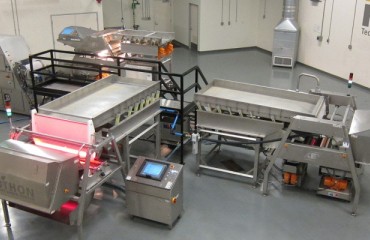
The Optyx has STG capabilitiesThe system automatically adjusts to stay on grade despite changes in incoming product quality. It eases use by eliminating subjective adjustments and dramatically reduces operator intervention, freeing personnel to focus on other tasks. It helps maximize sorting performance because the ideal adjustments are automatically made in real-time without delay, which improves the consistency of final product.
Read the whole story, including field test results, fine-tuning equipment’s programming, in the current issue of Potato Processing International