Exclusive: Sustainability - The Challenge of Finding the Balance

In short, sustainability is the efficient use of resources, which is vital for ensuring food supply for future generations. And technology is the answer to making the food sector more sustainable, efficient and profitable.
Although a lot of companies have started implementing measures to limit their energy use, large amounts of electricity, gas and water are still unnecessarily wasted on a daily basis through outdated or badly maintained machinery. Leaking devices, poor insulation, overheating, unnecessary lights and old fittings further aggravate the situation, all adding to the monthly energy bill. And, with energy prices soaring, keeping a close eye on consumption levels is essential for all operators to maintain profitability. By deploying sensing equipment, such as flow meters, motion sensors and kWh meters, consumption levels can be monitored across the whole plant. Once a control system has been installed, it can provide operators with detailed energy reports, giving them the viability they need to ensure energy is only used when and where it is needed.
Costs vs throughput
Energy costs are constantly rising so improving line efficiency is more important now than ever. Labor is getting harder to find and retain, so automation technology that helps achieve the desired product quality specifications while maximizing sustainability and efficiency has enormous value. The changing regulatory environment is challenging potato processors as sanitary design standards for equipment put more focus on the need to eliminate areas where bacteria can be harbored and ease cleaning. As many potato processors work to increase their production capacities, equipment on the line is being challenged to accommodate higher throughputs. As the quality of potato crops in select areas around the world become more variable due to changing climate conditions, processors are challenged to achieve their final product quality objectives while maximizing yields.
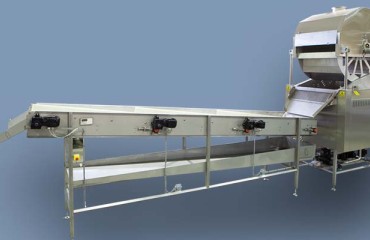
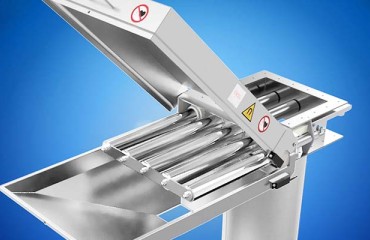
“At receiving, sustainability initiatives focus primarily on the amount of energy used to clean and transport incoming product as well as the number of people needed on the line. Here, Key’s vibratory and rotary sizing and grading systems are highly effective at removing dirt as well as sizing by diameter or length. This helps processors ensure optimal efficiency of downstream processing systems,” explains Jim Ruff, Vice President, Process Systems & Integration Solutions at Key Technology. “From peelers to packaging, potato processors around the world are reducing water use by replacing water flumes with vibratory conveyors. Compared to belt conveyors, vibratory conveyors such as our Iso-Flo® shakers are widely recognized as being inherently more sanitary because they have very few moving parts and present a bed surface that is easy to clean, which further reduces water and chemical use. Iso-Flo vibratory conveyors can be designed for product conveying, spreading, alignment, fines removal, scalping, grading, dewatering, deoiling, product distribution and more. The equipment that consumes the most energy in potato processing plants includes peelers, blanchers, fryers, dryers and freezers. Here, Key can help reduce energy use with our Iso-Flo conveyors that feed these systems. By more effectively spreading the product and evenly feeding a blancher, fryer, dryer or freezer, Iso-Flo improves the effectiveness of those systems,” Ruff adds.
Information management
Data management is certainly becoming more important than ever. Integrating data from every process and every piece of equipment increases visibility, reduces administrative tasks, optimizes processes and improves traceability, resulting in a smarter, more transparent and ultimately more profitable manufacturing process. Equipment manufacturer tna for example has recently launched an integrated data management tool to help manufacturers gain more and better insights into their production processes. With the new tna intelli-sys iPS 3 software, food manufacturers will be able to use a single, standardized platform to collate, visualize and evaluate live and historical information from every part of the production chain and across multiple locations. Thanks to the system’s real-time data acquisition capabilities, faults are detected much more quickly than humanly possible, ensuring downtime and waste are kept to an absolute minimum, while food safety and product quality are maintained at all times. The collation of detailed historical data, such as batch scheduling, tracking and tracing can be used for both internal communication purposes, but also as an external tool to prove regulatory compliance.
“In general, I believe that automation will continue to play a key role in the quest to improve efficiencies and ensure a more sustainable operation. For a lot of food manufacturers, automating key processes has not only helped them to optimize their production line, but also allowed them to boost their sustainability credentials by helping them reduce waste and gain greater control over their energy usage. In any case, collecting detailed and reliable data from as many parts of the production process as possible is vital for an effective and more sustainable production line,” says Shayne De la Force, chief marketing officer, tna. “At tna, we’re committed to delivering solutions that meet the highest efficiency and sustainability standards. For example, the oil flow control technology in our fryers was specifically designed to increase oil life span and allows manufacturers to accurately control the dwell time of the chips in the hot oil to ensure that each chip is fried evenly and to perfection. At the same time, our Florigo ultra-peel steam peelers can cut average maintenance costs by 50%, while reducing peel losses to a maximum of six per cent depending on the raw material. We also developed a solution that is able to recover the energy from the fryer, so it can be re-used for other processes, including blanching. To achieve this, the hot exhaust gasses and steam from the fryer are transferred through a heat exchanger that will produce warm/hot water (between 55–85°C). This water can then be used to pre-heat water for hot washing (potato chips) or in a heat exchanger of a belt fryer (French Fries) as heating source for the hot air,” De la Force adds.
Keeping energy and water costs low is a great way of achieving a more efficient and sustainable production process. However, as production output levels increase, so does the amount of discharges, whether that’s in the form of energy, wastewater, starch or potato peelings. With governments across the globe closing in on polluters, the lack of an effective environmental control system can not only incur huge financial losses, but in some cases even result in plant closures. Detecting violations and leakages quickly is therefore vital to maintain sustainable production. tna believes that by installing extra sensing equipment at selected points, plant operators can monitor any waste products before they are discharged. Data from the sensors can then be fed into the PLC system and compared with a set point of acceptability. Depending on the data, the process will either allow discharge or create an out of tolerance alarm, causing the process to stop before any harmful substances are introduced into the environment. The logged data will also provide a detailed record for submission to external monitoring bodies if required, eliminating the risk of large fines and ensuring a safe and efficient operation.
The role of technology
Automating food processing lines with the right technology can improve sustainability in many ways, according to the European Parliament’s report ‘Technology options for feeding 10 billion people’, such as “optimizing product quality, reducing quality losses and defects, and decreasing energy and water consumption.”
According to Bjorn Thumas, Director business development food, Tomra Sorting Food, “It is worth looking at each of these benefits in more detail. For reducing food loss and waste, in-line sensor-based sorting machines are very effective at optimizing product yield, ensuring quality and maximizing profits. Previously, when bad weather conditions damaged a crop, it would go to waste. For example, following a potato blight or hail damage to blueberries, the food producers would decide not to recover any of the crop at all. Now, food producers who partner with us can recover a small percentage of the crop through ‘reverse sorting’, removing the majority of bad input and recovering the one or two percent of good product available. In the past, this would have all gone to waste,” Thumas explains. Further, he adds that these technologies and platforms are inspiring companies to think outside of the box. Whereas in the past waste was waste, now processors have multiple waste streams depending on the quality of product: a misshapen carrot can be diced or juiced, a lower-grade one will be used for cattle feed, and only truly defective ones will be rejected.
In the case of reducing energy consumption and emissions, some machines such as peelers can reduce energy use through recycling and reusing. For example, Tomra’s Eco steam peeler uses 28% less steam than similar machines, making it the most efficient steam peeler in the industry, simply by reusing hot air. This reduces emissions, increases efficiency and brings down energy bills for the business. Similarly, while it was common for companies to freeze fruit and vegetables before sorting, new technology means they can reject defective product before freezing – optimizing the yield and cutting energy costs. Also, when thinking about reducing water usage, some technology solutions improve the efficiency of the whole processing line. Just as in the examples above, machines can now remove defects from salads and lettuce before washing them. This not only means that washing is more efficient, but also that water stays cleaner longer and needs replacing less frequently. As such, water consumption and waste water treatment are reduced significantly.
According to Key Technology, an innovation that contributes to greater efficiencies in potato processing plants is Information Analytics, a powerful suite of software capabilities that can be embedded within the company’s VERYX® and other digital sorters. Equipped with Information Analytics, the sorter continuously collects and stores a variety of information about the sort process and the product flowing through the sorter, whether that data is used to make sort decisions or not. It can be harnessed to better manage raw materials and optimize processes upstream and downstream of the sorter, in addition to improving the sorter’s accept/reject decisions, to enhance sustainability by increasing process yields throughout the plant. Another innovation that contributes to sustainability for potato strip processors is Sort-to-Grade™ (STG). This software enables Key’s digital sorters to more accurately maintain the most complex final product specifications without operator intervention while increasing yields by one to three percent. Equipped with STG, the sorter continues to target all foreign material (FM) for removal while STG recognizes and categorizes every surface defect and the dimensional characteristics of every individual strip to make each accept/reject decision based on how it will impact the aggregate ‘in the bag’ grade as defined by the processor. Sustainability is further improved when STG’s length profiling capability enables processors to eliminate mechanical length grading.
The PEF angle
Modern processing techniques with low energy and water consumption should be used, e.g. traditional pre-heating be replaced by PEF application. Besides water and energy usage raw material utilization has a major effect of overall sustainability. Reducing losses during peeling and cutting has major impact on product yield. PEF allows improved cutting with reduced starch release into processing water and a 1 – 2 % yield increase.
“Our PEF systems allow to replace traditional preheating and to reduce 90 % of the energy and water consumption associated with it. As no start-up or shut down time is required also overall production efficacy increases, the increased lifetime of cutter blades also contributes to higher productivity,” explains Prof. Dr. Stefan Toepfl, managing director of Elea. “Use of a PEF system allows to reduce water consumption by approximately 70 million liters of water on a 50 t/h production scale. In comparison to preheating 90 % energy reduction results. Better cutting and smoother product surface causes an approximately 10 % reduction of oil uptake during frying. Elea is world leading supplier of PEF systems with a scope of capacities from 1 to 70 t/h. In addition, our R&D as well as engineering team support with analytical services, product development and process engineering,” Toepfl adds.
In conclusion, it is obvious that sustainability will continue to be a key topic in future. The entire food industry is facing huge resource challenges at the moment. An ever-growing global population together with the effects of global warming means that food manufacturers will need to adopt more sustainable production processes in order to meet current demand and ensure future supply. In particular the potato industry has been hit hard in the last few years with poor weather conditions resulting in severe shortages in some regions. The impact on snack manufacturers has been considerate as they’re not only having to deal with higher raw material costs, but in many regions, unfavorable weather conditions have resulted in smaller potatoes. Innovative processing and packaging equipment together with advanced controls technology will play a key role for manufacturers as it will help them to be more efficient with their resources, while allowing them to maintain profitable in an increasingly challenging environment.