Continuous Peeling for Potato Chip Manufacturers
The Latest Technology and Considerations to Meet Demand While Increasing Quality
Potato processing companies have their work cut out for them. The snack food market is growing annually by 3.8%[i], with revenue equivalent to USD 109.80 billion in 2023. Potato chips make up a large part of that.
by Jack Grote, Lifecycle Leader for Grote Company
The global potato chips market size reached a value of USD 30.7 billion in 2022[ii]. Americans consume about 1.85 billion pounds of potato chips annually, or around 6.6 pounds per person[ii].
That’s A LOTof chips.
Keeping up with the demand requires the best technology to do the job efficiently.
Let’s look at some of the latest advancements in continuous peeling that can help enhance potato chip processing.
Continuous Peeling for Potato Chip Manufacturers
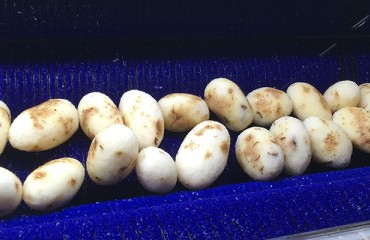
Continuous peeling can help chip manufacturers process more potatoes. With the right equipment, they can diversify their product mix. Incorporating abrasive peelers that scrub and wash potatoes improves sanitation and increases throughput.
Advantages of a Continuous Operation
There are several advantages to using a continuous operation setup:
- Quality — Continuous operation can produce consistent quality over time. This means that the chip you made three months ago will taste, look, and feel exactly the same as the one you made five minutes ago.
- Efficiency — You’ll also be able to perform real-time process monitoring and control. This helps translate into higher volume production with reduced processing time, storage space, and holding time.
- Cost of Labor — Continuous operation also requires far less labor than the batch production process. Once the production line is up and running, workers won’t have to change out or sanitize equipment as often as during batch processing.
- Water Usage Is A Major Consideration for Chip Producers
The potato peeling process requires a consistent supply of water in order to be successful. There’s increasing demand for better and more efficient water conservation techniques in the industry.
The water sustainability burden falls on both the processors and the manufacturers of the processing equipment they use. Look for water conservation opportunities, specifically when it comes to peeling applications. Manufacturers should look for solutions that:
- Recirculate process water
- Reduce water sent for treatment
- Clean peeler beds more efficiently
- Separate solids from process water
Water usage and treatment (and the resulting costs) in potato processing can be significant. Solutions that separate starch and solids conserve fresh water and reduce waste sent to the drain system as well as resulting water treatment costs. By incorporating these sustainability solutions into your operation, fresh water usage can be reduced by up to 90%. The solid waste can then be collected from a self-cleaning screen for resale.
The key to reducing water consumption lies in the processes and equipment used to peel, scrub, and wash potatoes. Look for machines that significantly reduce the amount of water used.
What to Consider Before Adding New Potato Peeling Equipment
As potato chip manufacturers think about adding equipment to their lines, here are some questions to consider:
- Document processes: Write down how your processes run. Which ones are you trying to automate? How much product do you run, at what speed, and for how long? How much waste do you create?
- Define specs and requirements: Consider equipment sizes, layout, integrations, utility needs, parts schedules, maintenance and sanitation, and accessibility/clearance. The more you know, the easier it is to identify viable options.
- Determine your goals: To evaluate potential solutions, first, understand your goals. Many food processors and manufacturers have goals including increased capacity for a new account or product, improved efficiency, and solving labor issues.
- Look at production rate: Look at your production rate. How much are you processing per hour? Are you looking to scale up from your current production rate?
- Consider functionality: What functionality do you need? For example, wash, rough scrub, and peel? Do you need to remove rocks and debris?
- Think about the footprint: Is this going in an existing line? What type of space constraints do you have? That could have an impact on the machine configuration. Other considerations include integrating with other equipment and where the peeler will be on the line.
- Don’t forget about maintenance: Maintenance can be tricky. Does your team have the capacity to complete the required maintenance? Do you need a machine that requires less maintenance due to staffing concerns? Maybe the supplier can provide maintenance at an additional cost, which might save time if or when the equipment needs servicing.
- Determine your budget: Food processing equipment can be a significant investment. Calculate payback times and ROI to gain the confidence you’re spending your money wisely. Be sure to consider labor, maintenance, parts, and utilities.
- Research your supplier: Look for a partner that demonstrates industry expertise and dependability. Also, consider their ability to provide support throughout the machine’s lifetime.
Equipment Options for Continuous Potato Peeling
When evaluating options for continuous potato peeling, factor in the use of flexible machines that allow for simple part changeouts. Rolls and other parts can be changed to optimize machine performance as the raw product profile evolves from season to season.
Chip manufacturers can use a configurable combination of spray bars, roller types, and other optional features, speeds, and settings to ensure the most effective peeling, scrubbing and washing process.
It’s typical to include multiple types of rolls in each machine:
- Brushes—brushes remove dirt and debris while achieving the desired peel level without losing yield.
- Coated Abrasive—these peel the product and leave a smooth surface.
- Sinewave Segment—this roller is mechanically timed to synchronize segment movement to abrasively peel odd-shaped products.
Continuous Potato Peeling Helps Chip Manufacturers Meet Demand for Quantity and Quality
Choosing to add continuous peeling machinery to the line can help potato chip manufacturers scale up to meet demand while producing higher-quality products that will have consumers craving more.
About the Author:Jack Grote is the Lifecycle Leader forGrote Company. In his role, Grote oversees the development and execution of Grote Company’s corporate-wide Lifecycle Business Strategy to support customers of all divisions, includingPFI andVanmark, with offerings to maintain and optimize their equipment purchases. Previously, he served as sales manager at Vanmark.
_________________
[i] Statistica, https://www.statista.com/outlook/cmo/food/confectionery-snacks/snack-food/united-states#:~:text=Revenue%20in%20the%20Snack%20Food,%24326.00%20are%20generated%20in%202023
[ii] Expert Market Research, https://www.expertmarketresearch.com/reports/potato-chips-market
[iii] Smithsonian Magazine, https://www.smithsonianmag.com/arts-culture/curious-history-potato-chip-180979232/#:~:text=Americans%20consume%20about%201.85%20billion,around%206.6%20pounds%20per%20person


