A Fair Slice
Minimum waste is essential when a product is being cut or sliced and manufacturers are addressing this - along with other needs - in the equipment on offer to potato processors.
What is better: tried and tested, like a boy scout's trusty pocket knife or state-of-the art and hi-tech like a four-blade razor or a Leatherman multi-function knife?
A lot depends on the processor's individual needs when it comes to volume cutting of product. French fries require different methods and levels of precision to halving potatoes or another processor's need for cubes or diced product.
And while there are new machines and a variety of methods out there, there is also much to tell about some other more classic ones.
Netherlands-based company Marcelissen is linked to Slitmaster - a company which produces just one - but trusty machine.
The design and development of this machine stems from the 1950s and has continued to be a success.
The Slitmaster is mostly used to cut potatoes in to French fries in different thicknesses. But also slices can be cut in different sizes as well. Besides potatoes, the machine has proved able to process other vegetables as well on a high quality level. The machine is solid, compact, and easy to clean and, therefore, easy to use and maintain.
Slitmaster has been used by big companies but also used in restaurants or small local cafeterias. The machine is suitable for small amounts of product, but depending on the exact type of Slitmaster, the capacity can run op to 3,500 kg/hr.
Apart from the good and high quality the end product has, the machine itself is very sustainable and reliable. A spokesman for Marcelissen said the company was using some that are almost 30 years old.
Customised solutions
Netherlands-based Tummers Machinebouw also specialises in hydro-cutting systems and can handle almost any situation presented by a potato processor and can even combine hydro cutting with mechanical systems on the same production line if such a set-up is required by the customer.
Combining mechanical and hydro-cutting methods is an option considered by processors dealing with a variety of products and not only French fries. While French fries are ideally suited to hydro cutting, other products, such as potato wedges and dice, need to undergo a mechanical cutting process.
All processors realise the need to keep down-time to a minimum.
Tummers offers a convenient system enabling operators to change knife blocks automatically should a production line blockage occur.
Kiremko too can offer versatility with its equipment, using hydro-cutting technology. Their QuadroFlow equipment is well known and the relatively recent introduction of the Ultra Fine knife block has been developed by the company in conjunction with several processors.
More traditional perhaps, but Urschel Laboratories' loyal and long-serving equipment - some of which have been in operation since 1998 - has a strong following.
Optimised slices
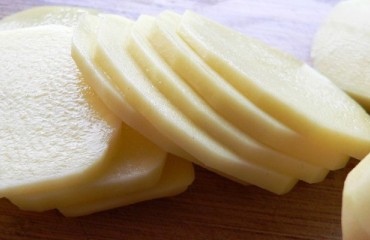
The TranSlicer 2000 Cutter, specialising in slicing elongated products such as larger types of potatoes, plantain, and cassava, produces very thin to thick flat or crinkle slices with a simple slicing wheel and speed changes. Its partner machine in the stable is the QuantiCut Dicer, accepting infeed product up to 10 inches in any diameter. By producing a wide assortment of dices and strip cuts, both crinkle and flat, the machine offers a large degree of flexibility and is still one of the most popular dicers in the market.
But, always searching for innovation, the company's new cost-effective option on the QuantiCut is an inexpensive insert slice knife. Recently, through the development of new knives, the QuantiCut now also offers a deep crinkle strip cut and this was honed with the more compact DiversaCut 2110 Dicer.
It is similar to the QuantiCut in accepting input diameter of 10 inches, but is smaller in size, and delivers improved cut quality through an engineered compact cutting zone.
Since then, Urschel's DiversaCut SPRINT Dicer has had, since its launch in 2007, an impact on the market too.
It accepts input size up to approximately 6.5 inches in any dimension and has many facets familiar to users of the 2110.
The drive train is isolated from the product zone to promote sanitation. It also has a stainless steel motor. It uses a cost-saving, insertable slice knife and it can be operated continuously for uninterrupted production.
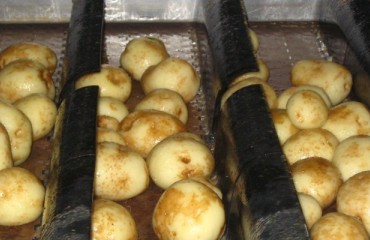
The Flo-Cut Sizer Halver from Flo-Mech, is designed specifically for the potato processing industry. As the name of the machine indicates, the machine carries out two operations, namely grading (sizing) and cutting (halving).
Potatoes enter the machine and all those under a pre-set diameter are graded out and allowed to pass straight through without being cut.
All those above this diameter enter the cutting section of the machine where they are accurately sliced in half before being reintroduced into the flow of acceptable product and finally discharged.
Graded potatoes enter the cutting (halving) unit and are transported towards the blades at the far end by a set of rotating shafts, each of which is fitted with a profiled plastic roller.
The rotation and design of these profiled rollers is such that the potatoes tend to settle into individual ‘pockets' which exist between the rollers.
As the potatoes travel between these pockets towards the cutting blades the centroid of each potato is precisely aligned with the cutting edge of the blade.
There are a sufficient number of these rollers to ensure that each potato is very accurately aligned before it is driven into the waiting, rotating cutting blade. Due to this precise alignment of the potatoes with the cutting blades they are always cut along their minor axis therefore giving maximum size reduction. Drive to the transport rollers is provided by a single fixed speed direct drive motor gearbox unit.
Definitely a cut above some of its competitors.