Canadian Potato Crop, Uneven Across the Country
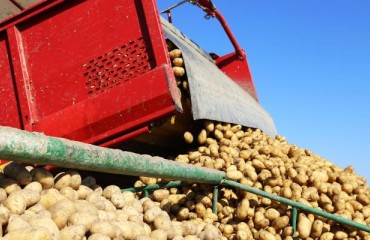
The 2021 growing season has provided a potato crop that is imbalanced across Canada. There are areas short on supply that will need potatoes that are available from areas with additional supply. The differential will be based on freight and the logistics of moving this crop.
“Potato harvest is in the final stages across the country. Most provinces (except for British Columbia) have enjoyed excellent harvest conditions without cool temperatures or wet conditions. Yields have been below average in the west, above average in the Central provinces, and exceptional in the Eastern region,” according to the last report from United Potato Growers of Canada (UPGC).
PEI Potato Harvest, Exceptional
UPGC’s experts said that 2021’s potato yield is exceptional in terms of both tonnage, and quality, after two years of disappointment. More exactly, PEI growers have about 85% of their crop harvested and many expect to finish up this week.
“Yields will likely be over 38,1 tons per hectare, in comparison to last year’s 28 tons per hectare. One would need to go back to 2006 to find a similar production level for the province,” the UPGC report mentions.
New Brunswick has ‘Best on Record’ Potato Yields
Harvest in New Brunswick is mostly complete except for those growers short of storage or delivering out of the field. Yields and quality have been outstanding, with some growers reporting their best on record, over many years of growing potatoes.
“Per acre yields are estimated at 39,2 tons per hectare compared to last year’s devastating drought which brought only 26,5 tons per hectare. Late rainfall was again key to bulking yield in maturing varieties and did create some spots in low-lying areas which growers tried to leave. [...] The resulting increase in 2021 production has attracted the interest of French fry processors who have already begun moving loads out of the province on a westward journey to those regions that are deficient in their needed supply of potatoes,” based on the UPGC’s report.
Quebec’s Potato Harvest ‘Above Last Year’
The potato harvest in Quebec is almost complete. There are still some acres to be harvested yet, but they are mostly being dug, washed, and packed directly from the field, as most storages are full.
“Yields are above last year’s 31,8 tons per hectare, likely in the 33,6-34,7 tons per hectare range for most regions. Quality is also very nice, and the size profile ended up better than earlier anticipated. [...] Any extra supply of processing potatoes should get picked up by the local processor. Demand on the fresh side has increased since the school opened, and chain stores have done a good job of promoting potatoes over the last 5-6 weeks,” UPGC’s experts mentioned.
Some Ontario Potato Growers are Opting for Temporary Storages
Ontario producers who grow potatoes for chips are about 95% complete of their harvest. Some growers have filled their storages for winter contracts and are stopped or waiting for field fry deliveries to clean up the rest of their crop.
“Tablestock producers are 90%-95% complete with their harvest but are in a similar situation with full buildings. Some are going to temporary storage while others are digging, washing, and packing out of the field. [...] It has been one of the better crops for many producers with well above average yields and nice size profiles,” according to the document.
Manitoba’s Potato Yields, Variable, Depending on the Growing Region
There is little to no unharvested acreage this year. Yield is variable depending on the growing region and availability of water. The growing season had 36 days with heat exceeding 30 degrees Fahrenheit which trimmed overall yields. The heat is also attributed to quality issues such as more smalls, lower gravity, and sugar ends. A few early storage issues have developed resulting in the early movement.
“Fresh potato growers have now completed their harvest as well. Harvesting conditions went from very hot, to cooler last week as some growers delayed for skin set. Rainfall throughout the growing season was patchy resulting in yields 70%-80% of a normal year. Table quality is decent with a reasonable size profile however, due to the summer heat there is a full spectrum of sizes, as some varieties produced fewer tubers (but bigger ones), while other varieties did not size up. Table growers are now eager to make up the shortfall in yield with improved prices”, the report mentions.
Saskatchewan Potato Seed Harvest, Completed
Seed harvest was completed in the province by October 16th. Harvest conditions started hot and dry, using irrigation water to soften clods. Conditions at the end became cooler as temperatures dipped to freezing at night. Crop yields are on par with a third-yr average of 28 tons per hectare with some growers reporting an additional 15% above that. The quality exceeds previous years with some seed surplus on certain varieties above the contract.
Excessive Heat Reduced Potato Yields Alberta
Harvest for most growers was completed by October 12th with excellent digging conditions throughout the operation and no unharvested acres this season. Excessive heat reduced yields by 10%-15%, with process growers particularly hard hit.
“Yields one year ago were 45,2 tons per hectare. Quality is all over the map, but the usual heat stress-related issues are expected to be prevalent. The resulting supply is short of what the industry needs and would like to see for the upcoming months. Yields are also off in the northern seed growing region, however size profile and quality are very nice,” the UPGC’s experts said.
Harvest for BC Growers is Complete
Harvest for British Columbia (BC) growers is complete except for those acres that were left out in the wet ground. Digging conditions had been excellent for the first 80% of harvest until September 17th when the Pacific coast received several inches of rain. It has been a bit of a struggle for the last of the crop coming out with more heavy rain on September 27th, but growers dug all they could. Due to heat, yields are below last year’s 37,2 tons per hectare but similar to the 2019 crop. Growers without irrigation suffered larger reductions in their crops. The heat created a slightly smaller size profile as well.