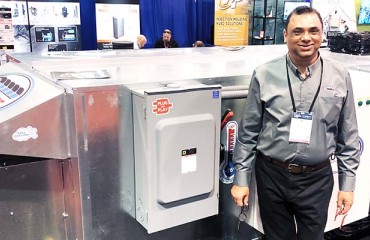
JD Wasir, Kooljet Sr. VP: ‘The Ideal Potato Storage Should Have a Proper Cold Supply’
Cold storage benefits humanity by preventing perishable commodities from spoiling and making them available off-season and in harvesting areas. This also serves two purposes: it relieves perishable produce growers of the need to sell their produce quickly at a low price, and it protects the nation from a commodity shortage caused by food spoilage during the off-season.
With the introduction of low-cost inverters (also known as variable-frequency drives or variable-speed drives) in the early 2000s, fan speeds could be adjusted and rates could be reduced once drying and/or pull-down were complete. This can result in significant cost savings; for example, reducing a fan to 80% of its full speed reduces energy consumption by around 50%. It is also an efficient method of disseminating the sprout suppressant.
In cooling mode, simple control systems work better with conventional refrigeration rather than complex ambient air cooling. As a result, the sole use of refrigeration to achieve a controlled pull-down is becoming more common in fresh market storage. More sophisticated control systems support fridge operation delays, allowing cooling to wait until night-time low temperatures are available or providing lower-cost energy tariffs to be used if fridge use is required.
Ideal potato storage should have a proper cold supply and return airflow pattern, uniform temperatures, and constant relative humidity levels across the entire potato storage. A correctly designed control system can effectively monitor all the desired levels along with the Parts Per Million (PPM) levels of Oxygen and CO2 in the potato storage.
More about the proper way to store potatoes in this exclusive Potato Business interview with JD Wasir, Kooljet Sr. vice-president.
Potato Business: What are the features of the control systems in your portfolio, and what are the criteria that influence the type of system best suited for a client's needs?
JD Wasir: We have a line dedicated to Potato Storage Refrigeration Systems, Kooljet packaged systems are offered with microprocessor controls complete with Color Touch Screen, Bacnet & Modbus options. Programmable Logic Controllers (PLC) are highly accurate for precise temperature controls. Our systems are designed with the most advanced technology presently available. Energy efficient Electronically Commuted (EC) Fans and Electronic expansion valves are used to get systems to operate at maximum efficiency.
How do automated control systems impact energy efficiency and the cost of maintenance?
Kooljet packaged systems, designed with automated control systems, will provide maximum efficiency and significantly reduce unit maintenance costs. Systems controls are constantly monitoring the system's operation. In case of alarm conditions, system controls will send the alert notification to the operator. On-time abnormal system notifications can avoid unit failure and can save substantial capital. The operator can even remotely monitor the system from his smartphone.
What are the challenges of potato storage and how does your equipment overcome these challenges?
Usually, potatoes stored at temperatures above 4.4 degrees Celsius for more than a few months will require a sprout inhibitor. Some of the Sprout Inhibitors contain Chlorine Fumes. Chlorine vigorously reacts and corrodes the Aluminum Fins of the Evaporator Coil, reducing the coil life.
Kooljet packaged refrigeration systems are equipped with optimal-designed evaporator coils complete with corrosion-proof coating on the aluminum fins and copper piping. The coated evaporator coils protect the aluminum fins and copper piping from chlorine gas fumes present in the potato storages. The Coated evaporator coils prolong the evaporator coil life compared to the conventional bare fin aluminum coils. Our water-based coating has the maximum salt spray hours in the industry.
Relative Humidity (RH) is the measure of the quantity of water vapor in the air at a certain temperature. Maintaining desired pile temperature is important but equally important is maintaining the optimum humidity. RH plays a vital role, as it affects the rate at which produce transpires. For best potato storage conditions, high humidity levels must be maintained.
Kooljet Systems are equipped with Optimal Designed Evaporator Coils with the Minimal Temperature Differential Between the Evaporator Coil Temperature and Produce Storage Temperature. The Minimal Evaporator Coil Temperature Differential avoids air to cool below its Dew Point temperature. Kooljet Systems helps to maintain the high RH levels in the storage and minimizes the Water Loss from Produce, maximizing product quality and value.
What criteria must potato storages meet for the successful operation of the control systems, and what are the options for the customers that have less than ideal storage facilities?
Pile temperature is the single most crucial factor in the keeping quality of stored potatoes. Respiration, sprouting, water loss, relative Humidity, Chemical composition, and other storage diseases are greatly influenced by temperature fluctuations. The rate of respiration changes with temperature variation in potato storage. Maintaining uniform storage temperature is critical, as fluctuations shorten potatoes' life expectancy.
Some variety of potatoes are required to be cooled gradually at the rate of minus 5/9 degrees Celsius every 1-2 days to the desired holding temperature. Cooling too rapidly will shock the tubers causing an excess buildup of sugars which can affect cooking and eating quality. Uneven temperature can also affect potato sugar levels. Accumulation of sugars from starch influences the processing of potatoes, leading to dark chips and French fries when the potatoes are processed.
Refrigeration systems designed with a microprocessor-based, accurately designed control system can avoid all the above issues in potato storage, increasing the shelf life of the produce.
What are the particularities of ambient cooling vs. refrigerated (mechanically ventilated) cooling, from the control system implementation standpoint?
Potato storage located in the colder climate region must fully utilize the cold ambient air to cool and maintain potatoes. A control must make use of the “Free Cooling” provided by Mother Nature. Kooljet offers packaged units equipped with the Free Cooling option, which is extremely beneficial in colder climate regions.
During free cooling mode, once the ambient temperature is lower than the room set point, the controller shuts the compressors off and opens the built-in modulating economizer to bring the cold outside air into the room. The option not only saves energy in the wintertime but also extends the life span of the unit due to less wear and tear. this option can be used for warmer climate regions, the unit economizer can also be used to introduce fresh air in the cold room. The amount of oxygen and CO2 levels in the room determines the intake of fresh air. Plenty of fresh air can delay or even prevent the senescent sweetening of potatoes. A heating element may be installed in the fresh air supply duct to warm up the incoming air, if necessary.
Kooljet systems can be Micro-processor controlled, complete with electronic sensors for monitoring the Co2 levels in PPM, relative humidity in %, and the temperature in Fahrenheit degrees or Celsius degrees.
Kooljet has a global footprint and has been assisting farmers since 2001. Kooljet systems are used by many potato operations in Canada and elsewhere - including McCain Foods, Canada-China, and Calbee Potato in Japan.