What Happens to Potato Plants Exposed to Extreme Smoke
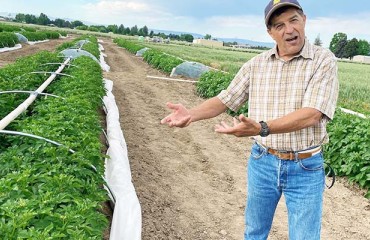
According to preliminary data from research conducted by the University of Idaho (U of I) and Boise State University, potato plants exposed to extreme smoke generated lower marketable yields than smoke-free plants.
The results varied depending on the variety, with heavy wildfire smoke exposure related to smaller Clearwater Russets and more unusable and misshapen Russet Burbanks. The experiment involved pumping synthetic wildfire smoke onto potato plots covered in plastic.
The two-year research aims to determine how long-term exposure to wildfire smoke affects potato yields, crop quality, and chemical composition. Project leaders Mike Thornton, a professor in the University of Idaho's Department of Plant Sciences, and Owen McDougal, chair of the Boise State University Chemistry Department, expect the research will aid in the identification of smoke-resistant potato varieties.
“As we look at these varieties, if we see some that are less responsive to smoke, growers, and processors can start looking at using those long term,” Thornton mentioned.
Based on preliminary data, farmers who raise Russet Burbanks stand to lose more money due to smoke than growers who raise Clearwater Russets.
Smoke exposure decreased the Clearwater Russet crop's output of potatoes weighing more than six ounces by 12%, but it did not affect the proportion of misshapen tubers. The size profile of Russet Burbank crops was unaffected by smoke exposure, but there was a 3% rise in misshapen tubers weighing more than 10 ounces.
The experimental tubers' potatoes and the fries made from them by the U of I Food Technology Center in Caldwell were chemically analyzed by McDougal's laboratory as soon as they were harvested, and a second study will be done this spring after six months of storage.
According to McDougal's chemical study, there were no differences in the concentrations of asparagine, an amino acid necessary for the creation of acrylamide, an ingredient in fried foods that may cause cancer. Additionally, he will assess how potato-reducing sugars, which are a factor in the darker and less appealing fry hue, may be impacted by smoke exposure during storage.
“We’re also looking at storage and whether smoke exposure negatively impacts potatoes’ storage resilience,” McDougal said.
From July 11 to August 18, Thornton and his coworkers at the UI Parma Research and Extension Center piped a mixture of hard and soft wood smoke into potato plots covered in plastic for three hours each morning. The covers were then removed after the treatments.
Even during bad wildfire seasons, the experiment's smoke amounts were much higher than those found in nature, according to Thornton. Plastic covers increased temperature by up to 9 degrees in the early morning and increased humidity by up to 20%, which likely stunted the potato harvests by interfering with the evaporative cooling of leaves. Thornton intends to use shade covers to keep the temperature down and fans to circulate the air, in part to control humidity, when the team experiments this summer.
Additionally, according to Thornton, the study's data may ultimately show that smoke reduces potato yields and should be covered by crop insurance programs.
McCain Foods put together a research team, assisted with the project, and provided direction.