Smartphone-based DRS Detection of Potato Late Blight Disease
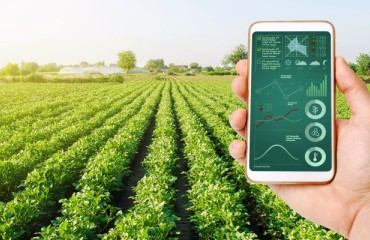
Pre-symptomatic detection of late blight disease in potato leaves is now possible using a smartphone-based, portable visible-near-infrared (NIR) diffuse reflectance spectroscopy (DRS) technique.
A prototype of a smartphone-based DRS spectrophotometer has been recently developed, and a micro-USB cable is used to attach it to a smartphone. A smartphone app may be used to start the measurement and retain the data when using the portable spectrophotometer for noninvasive leaf DRS measurements in the field. Researchers and farmers may easily identify plant diseases with this portable, user-friendly gadget.
The diffuse reflectance of samples is measured using the DRS technique throughout a wavelength range of 600 to 950 nm, which corresponds to the visible and short-wave near-infrared (NIR) spectral area. The system operates by shining a light on the potato leaf's surface and measuring the amount of light that is reflected. The light that is reflected from a leaf's surface contains information about the chemical makeup of the leaf, including whether or not certain biomolecules may be signs of late blight disease. On a variety of potato leaves affected with late blight disease, the researchers tried the technique. They discovered that it could properly identify the illness before any outward signs arose.
Compared to conventional techniques, the novel method for identifying late blight disease has several benefits. Since it does no damage, the potato plant may keep growing and making potatoes after the measurement is taken. This new technology, which collects measurements in only a few seconds and has a sensitivity and specificity above 90%, is more effective and accurate.
The DRS approach, according to the researchers, may be used to regularly check potato crops for late blight disease. Additionally, it might be used to quickly test potato types for disease resistance, enabling farmers to select cultivars that are less prone to infection.
The study emphasizes how portable DRS has the potential to be a quick and non-destructive technique for identifying plant diseases. The technique might be modified to work with other crops and illnesses, enabling farmers to recognize and address hazards to plant health more rapidly.
The terrible disease is known as potato late blight damages potato plants all around the world and results in enormous financial losses. If not controlled, it is brought on by the organism that resembles a fungus and is called Phytophthora infestans. Potato blight has occurred on several occasions throughout history, most famously during the Irish Potato Famine that lasted from 1845 to 1862.
The time-consuming visual examination of the plants used in conventional approaches for disease detection might produce false positives and negatives.