Lemken Introduces Its First Weeder Harrow
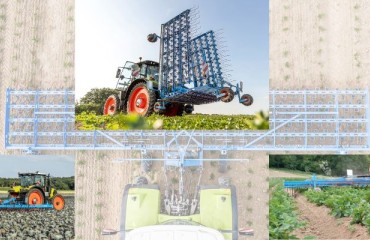
Lemken introduced the Thulit, its first weeder harrow, to complete its line of mechanical weed control tools. The agricultural machinery expert pioneered the development of this equipment, which has four beams and eight rows of harrow tines.
“Complex spring combinations are replaced by an innovative hydraulic tine pressure adjustment, which ensures that the tines deliver more even pressure across the full working surface. The pressure can be continuously adjusted to up to five kilograms while driving. As a result, the Thulit does an outstanding job during the sensitive crop growth stages,” a recent Lemken press release reveals.
The tines are set with a line spacing of 31.25mm to prevent obstruction. Tine bearings that are stable, true-to-track, and wear-free provide effective weed removal. The harrow tines are easily replaced thanks to a simple quick-change system. The Thulit's accurate and continuous ground contour following, along with consistent tine pressure, makes it a highly flexible implement, even on very uneven terrain and in ridge crops. It is nearly rare to find plants getting entangled underneath the frame due to its high clearance height and smart construction that eliminates the need for traditional springs. The adaptable hydraulic system also allows for width section control within the frame sections, avoiding several passes over the field.
“Minimizing the frame weight was a core aim in designing this machine. To achieve this, the number of moving parts was significantly reduced in comparison to similar models, ensuring that the Thulit can also be used easily with tractors with low lifting capacity. The driver has a clear view of the harrow tines during work and therefore a constant view of work results. For transport, the tines fold in automatically for an increased level of safety,” the company engineers added.
The Thulit harrow will initially be available in limited quantities in working widths of six and nine meters in spring 2024.