A First Organic Potato Crop for the Honduran Lenca Women

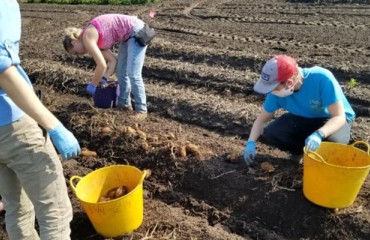
In southwestern Honduras, a group of indigenous Lenca women has started harvesting their first organic potato crop as part of a project run by Oxfam with support from the Spanish Agency for International Development Cooperation (AECID).
“This is our first experience growing organic potatoes. We’re having good results despite this being an initial experiment,” according to Mercedes Garcia, coordinator of the grassroots Nuevo Amanecer (New Dawn) project in San Pedro de Salimania, a village in the southwestern Honduran department of Intibuca.
Garcia's group is one of 36 that make up Amir, an organization that gets support from the AECID to help Lenca women run various farming businesses, products that are afterward sold either locally or at a green market.
The AECID's assistance has been crucial in enabling these Lenca women in San Pedro de Salimania, just a few kilometers from the town of Intibuca, to purchase productive land for growing crops, another piece of property for a general store, as well as the resources needed for a warehouse to store harvested agricultural goods and increase their sales.
Amir is made up of over 650 indigenous women from 36 different community groupings who have been educated on human rights and trained in farming methods.
“We have this parcel to put into practice the techniques we learned in our rural school,” Garcia told EFE news agency, cited by La Prensa Latina.
According to her, organic farming is sustainable and requires less capital outlay than farming that relies on chemicals.
The woman added that smaller potatoes that are not sold would now be used to produce the seeds that were previously imported from the Netherlands, Canada, and the United States.
“From the first (harvest) we’re going to sell the biggest ones, and we’re going to leave the (small ones) for seeds,” Garcia added.
Women's involvement in community organizations is also assisting in the transformation of Lenca homes, the majority of which are found in the southwest departments of Intibuca, Lempira, and La Paz and are frequently the targets of male chauvinism and violence.
According to Amir President Modesta Sanchez, these indigenous women once required their husbands' consent to leave the house, but as they have grown more organized, that has been changing. She also emphasized the significance of the AECID's help.
“We’ve succeeded in developing ourselves and valuing one another [...] I now feel empowered because I can decide my things, I sow (my crops), I sell and I have my little bit of income and that’s helped me a lot,” Sanchez added.
One of the 15 female members of Nuevo Amanecer, Maria Cecilia Martinez, claimed that before organizing, she and the other women were restricted to their houses and lacked access to employment options and a way to improve their living situations.
However, she continued, they found “new work possibilities” and realized they could farm the land just as well as men and support their families by joining small neighborhood groups and then Amir.